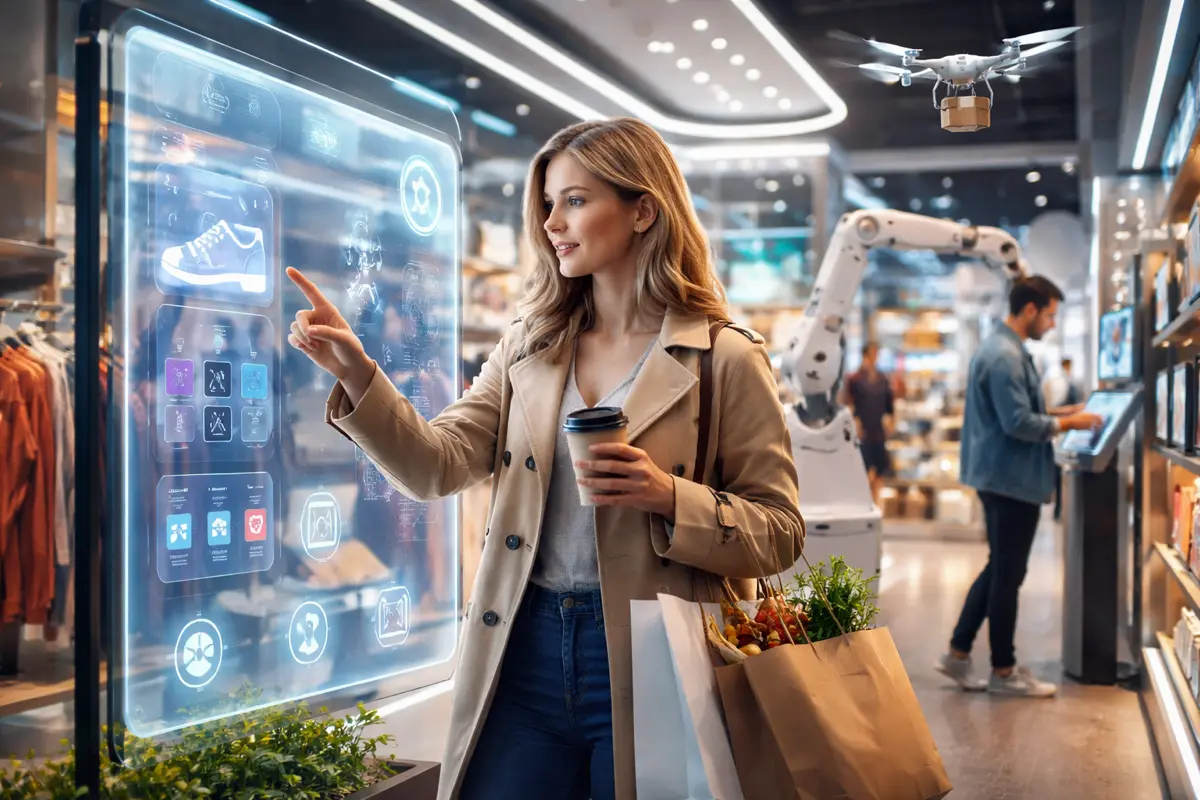
Another year in the retail sector is behind us. One of the main challenges retailers had to face was the introduction of the deposit return system. The regulations, which came into force on 1 October, sparked extensive debate, particularly around the organisational and financial challenges involved in implementing the required changes in stores. Another significant development for the retail industry was the designation of Christmas Eve as a non-working day. In exchange, the three Sundays preceding Christmas became trading Sundays. Against the backdrop of these far-reaching changes, retailers continued to grapple with everyday issues that are likely to have the greatest impact on their businesses in 2026. These include margin pressure, labour shortages, rising consumer expectations and changes in shopping habits. What trends are associated with these challenges?
Retail trends 2026: profitability driven by new technologies
The economic situation affects both the revenue stability of retail chains and consumers’ wallets. Global research from 2025 shows that 27% of consumers have taken on additional work, while 18% have had to rely on savings or take on debt [1]. Economic uncertainty is clearly reflected in purchasing behaviour: every second person has switched to cheaper products, and two out of three primarily buy essential goods [1]. Price has become the key factor in choosing a store. While reducing margins can help retail chains build a competitive advantage, it also brings them dangerously close to the threshold of profitability.
Opportunities to optimise revenues should therefore be sought in IT solutions. According to 2025 data, almost four in ten retail organisations (39%) are implementing cost-reducing technologies for this purpose [2].
One example of such a solution is iXpos-Mobile a mobile application for store staff. It speeds up day-to-day operations and reduces the risk of manual errors, resulting in lower costs associated with back-office and shop floor tasks. Its key features include:
- barcode scanning, enabling faster stocktakes and goods receipt (the average time required for warehouse operations can be reduced by up to 40%),
- price checking and label printing,
- automatic stock level updates after tasks are completed,
- offline mode – data is synchronised once the device reconnects to the network,
- automatic alerts about stock shortages or surpluses,
- fulfilment of e-commerce and m-commerce orders.
More information about iXpos mobile applications can be found HERE.
Retail trends 2026: inclusive workplaces
In the near future, the retail sector will continue to face challenges related to labour shortages. This gap is being partially filled by people with disabilities, who are increasingly willing to take up employment in retail. Globalisation of the labour market also presents new opportunities. According to data from Statistics Poland (GUS), more than one million foreign nationals are employed in Poland [3], many of them in the retail sector.
Onboarding employees with disabilities or those who do not speak Polish fluently requires an appropriate, inclusive approach. Technology used in stores plays a crucial role in this process.
An example is a POS system that allows the interface to be switched between different language versions regardless of the fiscal system in use. This means that the cashier can operate the interface in their own language, while the customer sees messages displayed in Polish. This is one of the features available in the iXpos sales system.
Retail trends 2026: social commerce
A relatively new sales channel continues to strengthen its position year on year: social media. Today, social platforms are no longer used solely for advertising, brand-building or communication with audiences. Some social networks and apps now incorporate built-in sales platforms, with Facebook Marketplace being one of the best-known examples.
Is it worth investing effort in these channels? Global research suggests that it is. One in three consumers already purchases products via social media. This is most common among Generation Z (44%) and millennials (40%), although the figures for Generation X and baby boomers are also notable, at 28% and 17% respectively [2]. Poland is no exception and represents a strong market for social commerce. One in five Poles has already encountered shopping via social media, and one in three of those consumers makes purchases through these channels at least once a month.
In 2026, it will certainly be worth taking a closer look at TikTok Shop, which, according to expert forecasts, may enter the Polish market later this year. Its potential is demonstrated by the fact that in the third quarter alone it generated global sales worth USD 19 billion [5]. This is hardly surprising, given that TikTok is currently one of the most popular social media applications. If a company has not yet started marketing activities on the platform, now is the time to do so. Building an engaged community will undoubtedly have a positive impact on financial performance once TikTok Shop becomes available in Poland.
Retail trends 2026: personalisation of promotions and experiences
The final trend identified also relates to changing consumer expectations – this time focusing on the need for personalised promotions and experiences. The data is clear: almost four in ten consumers (39%) want to receive personalised recommendations or experiences [2]. Meanwhile, one in four Poles admits they would be more likely to use the offer of a particular store if they received personalised promotions [4]. Estimates suggest that personalisation can lead to a 4 – 6% increase in both revenue and customer retention [6].
A major obstacle to implementing a personalisation-based promotional strategy is outdated, monolithic systems with complex infrastructure. These make it difficult to integrate sales channels, resulting in customer purchase history data being stored in separate databases. As a consequence, it is challenging to create effective, individualised promotions. The solution lies in a gradual transformation towards a modular architecture and event-driven integration. We discussed the technical aspects of this process in more detail in this article on our blog: Omnichannel in retail – a practitioner’s perspective.
Challenges in retail? You can reduce them!
Almost every year brings significant changes to the retail sector. In 2025, these included the deposit return system and regulations banning trade on Christmas Eve; this year, retailers will need to implement the National e-Invoicing System. In addition, they will continue to face challenges related to the economic climate, evolving customer expectations and labour shortages. In particular, this concerns the four key issues discussed in this article:
- the savings-driven behaviour of consumers, who place increasing importance on price when choosing a store,
- the globalisation of the labour market, requiring an inclusive approach to onboarding new employees,
- the development of new sales channels, including social commerce,
- growing consumer expectations around the personalisation of promotions and experiences.
Modern technologies offer an effective way to mitigate these challenges by streamlining daily store operations and enabling the automation of sales processes. On the one hand, they reduce operating costs; on the other, they contribute to revenue growth.
Sources:
[1] Salsify, 2025, Consumer Research. Meet Every Shopper, Every Channel, Every Moment, s. 6
[2] Adyen, Retail Report 2025
[3] GUS, 2025, Cudzoziemcy wykonujący pracę w Polsce w maju w 2025 r.
[4] Gemius, Polskie Badania Internetu, IAB Polska, 2025, E-commerce w Polsce 2025
[5] Washington Post, How TikTok came to rival eBay as a global online shopping destination
[6] EuroCommerce, The State of Grocery Retail Europe 2025


